
Singapore is no longer too small for excellent legal software
Seven lessons for choosing legal tech in an age of abundance

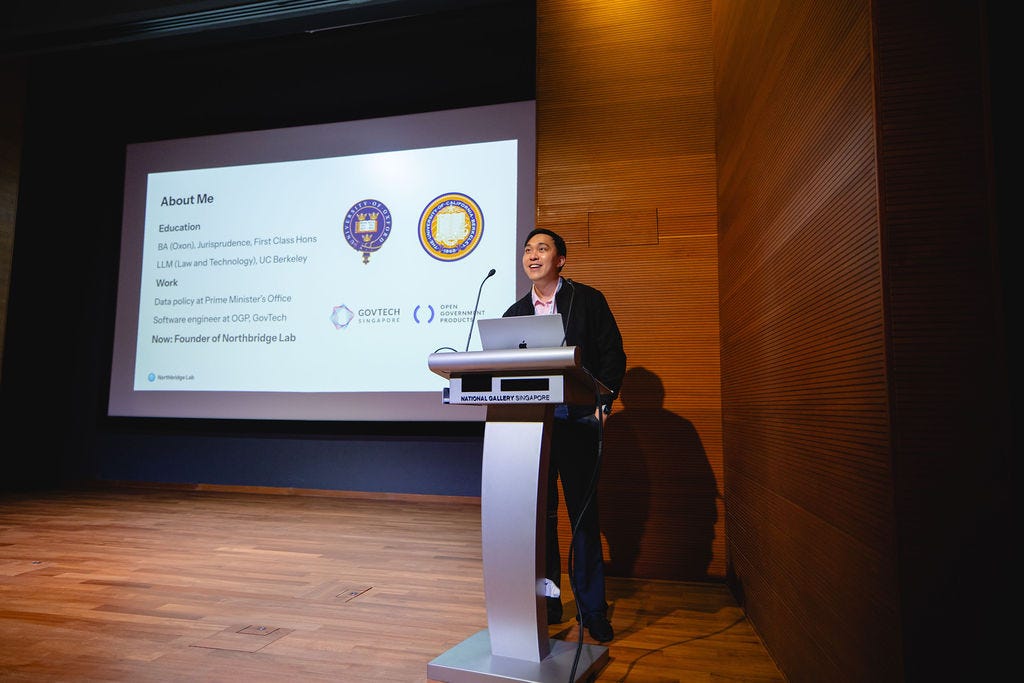
Last Friday, I presented our flagship product, Dossier, at the Law Society’s Legal Tech Fair at the National Gallery. The programme was aimed at small and medium-sized firms interested in legal technology.
In his address, Dharma Sadasivan, Co-Chair of the Law Society’s Technology & Innovation Committee and Chief Strategy Officer and General Counsel at STABILITY, surveyed the burst of legal-tech launches since ChatGPT arrived in late 2022. He ended with an observation that stayed with me:
Our challenge today is not a lack of legal innovation, but rather navigating our reaction to it.
He is right. But I want to push the point further. I believe our market can now support excellent software built around our own practice areas and ways of working.
AI has made software cheaper to build and refine. It has not made trust cheap. That combination changes both what can exist and how you should choose it.
Here are seven lessons I took away from the Fair.
1. We live in an age of (false) abundance
Dharma’s survey was genuinely striking: global platforms shipping libraries of legal AI agents, established products adding AI assistants, Claude for Legal, large firms announcing custom AI platforms, and a growing list of Singapore-built products alongside them.
Look closer, though, and much of this abundance is thinner than it appears.
A good share of it is legacy software with AI bolted on: the same document or practice management system as before, now with a chat panel for you to figure out what it can do. The underlying workflow has not changed. The vendor’s understanding of your work has not changed.
Another share is built overseas for other markets. The product may be polished, but it assumes other court processes, other forms, other client expectations. Singapore context is an afterthought, if it appears at all.
So the real challenge is not sorting through a hundred lookalike chatbots. It is asking a harder question: what would this practice look like if it were rebuilt from the ground up with AI? That, I think, is what navigating our reaction to innovation actually requires.
2. AI means small markets can now support excellent software
Singapore used to present an awkward commercial problem. A product built only for our legal market might never have enough customers to justify the cost of building and refining it. Firms were left choosing between a polished foreign product that did not quite fit and an expensive bespoke project that might never be finished.
That trade-off is breaking down. AI has cut the engineering effort behind interfaces, integrations and the hundreds of small refinements that turn a prototype into something pleasant to use.
In other words, AI has reduced the minimum market size required to support excellent software.
That is the bet I am making: a market as narrow as a single Singapore practice area can now sustain a properly built product with deep localisation, down to a firm’s own precedents and preferred drafting style.
A global brand is not automatically more polished. An enterprise price tag with flashy marketing is not proof of local fit. Singapore firms can now insist on software that is both polished and built for how you actually practise.
3. A strong demo is now a weaker signal
Many law firms I speak to have been burned by IT vendors. The pattern repeats: an impressive pitch, then an unfinished implementation, weak support, or a developer who lost interest once the invoice was paid.
Part of the blame lies in how these projects were bought. Time-limited grants and subsidies tempt everyone to frontload cost into one large build. But software, especially AI software, is never finished. Models change, court practice changes, the firm’s needs change. A vendor paid entirely upfront has little commercial reason to stay interested. I have written before about what pricing models do to vendor incentives.
AI has now made the impressive pitch even cheaper to produce. A polished demonstration proves less about a vendor than it did two years ago.
So consider what a demo cannot show. Ask about real, sustained usage on real matters. Ask for existing customers. Ask who answers when something breaks, and what happens when your requirements change. Ask what happens to your files if the relationship ends: can you export your data in a usable format and carry on without the vendor?
For our part, Northbridge Lab’s products are already used by Singapore law firms on live matters: more than 1,000 cases, over 40,000 documents processed and over 1,600 documents generated to date. I would rather you heard about it from clients than from me, so prospective customers are welcome to ask for references.
4. Code is cheap. Trust is not
A lawyer showed me an application he had built himself using AI coding tools. He is not a software engineer. He simply described what he wanted in plain English and let the AI write the code, an approach now called “vibe coding”.
The application was genuinely useful. But to his credit, he had already worked out the harder truth: he could not responsibly run real client files through it.
AI has made code generation cheap. It has not made software operations cheap.
The visible feature is a small part of the product. The invisible part is what happens afterwards: which third-party providers touch it, whether the software’s own supply chain is secure, and who is accountable when something goes wrong. Supply-chain attacks on widely used software components are now routine, and a hobbyist vibe coder rarely has the apparatus to withstand them.
Law firms should apply this test to us too. We vet our third-party providers rigorously and curate our own software supply meticulously.
Northbridge Lab has also recently completed the assessment for the Cyber Security Agency of Singapore’s (CSA) Cyber Essentials Mark, including the AI Security and Cloud Security pillars. This matters because it is an independent third-party review of our security practices: you do not have to take my word for it. The mark is part of CSA’s national SG Cyber Safe programme, and the public directory of certified organisations includes names such as Allen & Gledhill, Deloitte and ST Engineering.
The assessment covered the actual SaaS environment our legal workflows run on, from document upload and processing through to retention, deletion, monitoring, backup and incident response. No certification answers every question, but a vendor should at least be able to show that the operational layer exists, explain it plainly and take responsibility for it.
5. Every legal-tech product competes with ChatGPT and Claude
Claude and ChatGPT are powerful, inexpensive, improving quickly and not going away.
I use these tools every day, and I have trained legal teams on using Claude, ChatGPT and Copilot effectively. There is a real learning curve: choosing the right product and tier, understanding confidentiality and retention terms, matching tools to tasks, and making good usage a firm habit rather than one enthusiast’s hobby.
But this cuts against legal-tech vendors more than it cuts against lawyers. A legal-looking interface wrapped around the same underlying models is weak differentiation. Specialised software has to offer something a blank chatbox cannot: Singapore context, practice-area depth, workflow integration, source verification, structured work product, firm-level customisation.
If a product cannot say clearly what it adds beyond Claude or ChatGPT, it is not worth buying.
6. Not every legal problem needs a platform
“Legal AI” is one label covering three very different purchases:
Use Claude or ChatGPT for open-ended, lawyer-directed work: exploring, testing and refining an answer you will check yourself.
Use a focused tool for a narrow, repeatable pain point.
Use an integrated vertical product when several stages of work, source materials and domain rules must hang together.
Sometimes the right answer is the first one, which may mean buying nothing from a legal-tech vendor at all.
An integrated product earns its keep when the problem extends beyond a single task: several stages have to connect, the same rules must be applied consistently, or the work must remain traceable from source documents to final output.
Start from the pain point, then buy the smallest category of tool that solves it. Do not buy a platform because the vendor happens to have one to sell.
7. Good software levels the playing field
A large firm can surround Claude or ChatGPT with people: associates to check outputs, knowledge lawyers to build prompt libraries, innovation staff to run pilots, IT support to manage the rollout. A smaller firm has none of that machinery. It needs the machinery built into the product itself.
That is the standard to hold a vendor to before paying serious recurring fees. The product should connect the stages of work, adapt to the firm’s own forms and preferences, produce outputs you can trace back to source, and end in an ordinary Word document. That was the shape of the workflow I showed at the Fair: a scanned, unsearchable pleading went in; a verifiable, lawyer-controlled draft came out, in Word.
Here smaller firms hold a genuine advantage: they are more nimble. In my experience, larger firms are big ships. New tools mean committees, change management and long rollouts. I have watched our own clients prove this: one small firm decided in a day, and within two weeks was running every case through our software.
Well-chosen software will not replace professional judgement. What it offers a small team is the operational leverage of a much larger firm, without the headcount.
What this means for vendors like me
Judge us the way I have argued you should judge any vendor: on real usage, operational discipline, and what we add beyond the underlying models, not on how good the demo looked. And do not take my word for any of it: ask us for client references.
We also practise what we preach about fitting the tool to the problem. Sometimes the right answer is training your team to get more out of Claude, ChatGPT and Copilot, and we do that. Sometimes it is a small, focused tool for one painful, repetitive task, and we build those. And where the same connected problem recurs across a practice area, we build the integrated product, run it in production and keep improving it as more firms use it.
So if your firm has a recurring pain point, I want to hear about it. I will tell you which kind of tool it actually needs, even if the honest answer is that you do not need us.
Singapore’s legal market is small. That was always the excuse for mediocre legal software, and the excuse is gone. The advantage now belongs to the firms that notice first.
You can reach me at warren@northbridgelab.com.